
Chicken katsu curry is Japanese comfort food at its best. Crispy, panko-breaded chicken cutlets sitting in a pool of rich, slightly sweet curry sauce, served over rice. The contrast is everything—the crunch of the breaded chicken against the smooth, savory curry. The mild sweetness of Japanese curry against the neutral rice.
This isn’t the fiery, complex curry of Thai or Indian cuisine. Japanese curry is milder, thicker, almost gravy-like, with a subtle sweetness from apple and honey. It’s the kind of thing that disappears from your plate before you realize you’ve eaten it all.
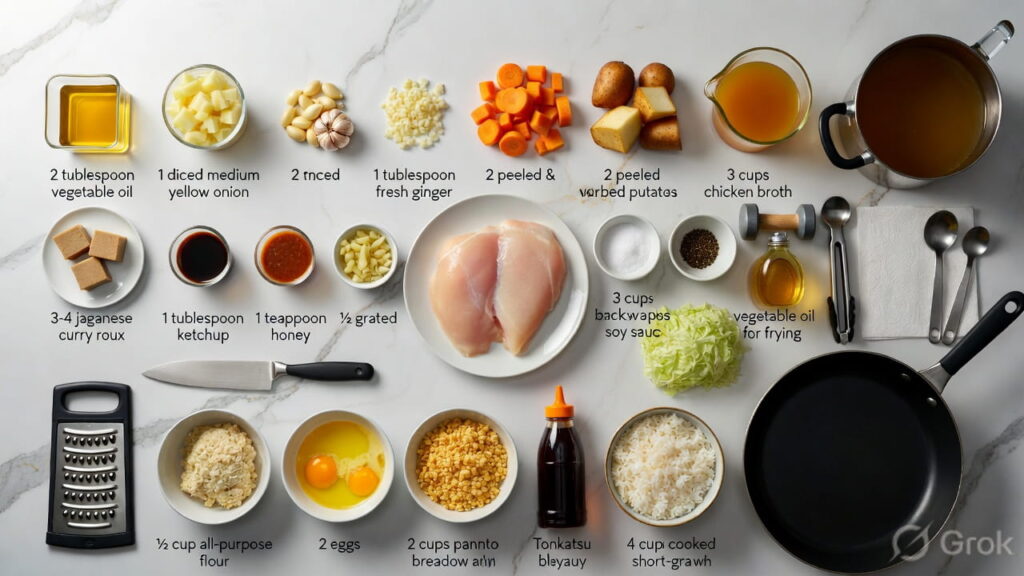
What You’ll Need
For the Curry Sauce:
- 2 tablespoons vegetable oil
- 1 medium yellow onion, diced
- 2 garlic cloves, minced
- 1 tablespoon fresh ginger, minced
- 2 medium carrots, peeled and diced
- 2 medium potatoes, peeled and cubed
- 3 cups chicken broth
- 3-4 tablespoons Japanese curry roux blocks (like S&B Golden Curry)
- 1 tablespoon soy sauce
- 1 tablespoon ketchup
- 1 teaspoon honey
- ½ apple, peeled and grated (adds sweetness and body)
For the Chicken Katsu:
- 4 boneless, skinless chicken breasts (about 6 oz each)
- Salt and black pepper
- ½ cup all-purpose flour
- 2 large eggs, beaten
- 2 cups panko breadcrumbs
- Vegetable oil for frying
For Serving:
- 4 cups cooked short-grain white rice
- Tonkatsu sauce (or Worcestershire sauce)
- Shredded cabbage
Tools:
- Large pot or Dutch oven
- Large skillet
- Three shallow bowls or plates
- Meat mallet or rolling pin
- Plastic wrap
- Tongs
- Paper towels
- Chef’s knife
- Cutting board
- Grater
- Measuring cups and spoons
Making the Curry Sauce
Heat 2 tablespoons of vegetable oil in your large pot over medium heat.
Add the diced onion and cook for about 5 minutes until softened and translucent.
Add the garlic and ginger. Cook for 1 minute until fragrant.
Add the diced carrots and cubed potatoes. Stir to coat them in the aromatics.
Pour in the chicken broth. Bring to a boil, then reduce heat and simmer for 15-20 minutes until the vegetables are tender.
Break the curry roux blocks into pieces and add them to the pot. Stir until completely dissolved. The sauce will thicken significantly.
Add the grated apple, soy sauce, ketchup, and honey. Stir to combine. Let the curry simmer gently on low heat while you prepare the chicken, stirring occasionally. If it gets too thick, add a splash of water or broth.
Preparing the Chicken
Place each chicken breast between two sheets of plastic wrap. Use a meat mallet or rolling pin to pound them to an even thickness of about ½ inch. This ensures even cooking and makes them easier to eat.
Season both sides of each breast with salt and black pepper.
Set up your breading station with three shallow bowls: one with flour, one with beaten eggs, and one with panko breadcrumbs.
Breading the Chicken
Dredge each chicken breast in flour, shaking off any excess.
Dip it in the beaten eggs, letting excess drip off.
Press it firmly into the panko breadcrumbs, coating both sides completely. Press the breadcrumbs on so they adhere well.
Place the breaded chicken on a plate. Let it rest for a few minutes while you heat the oil.
Frying the Katsu
Pour about ½ inch of vegetable oil into your large skillet. Heat over medium-high heat until it reaches about 350°F. To test, drop a few panko crumbs in—they should sizzle immediately.
Carefully place the breaded chicken in the hot oil. Don’t crowd the pan—work in batches if needed.
Fry for 4-5 minutes on the first side until deep golden brown. Flip carefully with tongs and fry for another 4-5 minutes on the second side. The chicken should be cooked through (internal temperature of 165°F) and the coating should be crispy and golden.
Transfer the cooked katsu to a plate lined with paper towels to drain. Let it rest for a couple minutes.
Slicing and Serving
Slice each katsu crosswise into strips about 1 inch wide.
Place a mound of rice in each bowl. Ladle the curry sauce over one side of the rice.
Arrange the sliced katsu on top of the rice, fanning out the pieces slightly.
Drizzle tonkatsu sauce over the katsu or serve it on the side for dipping.
Add a small pile of shredded cabbage on the side. The fresh, crunchy cabbage is traditional and provides a nice contrast to the rich curry.
This makes 4 servings.
The curry sauce can be made ahead and refrigerated for up to 3 days or frozen for up to 3 months. The katsu is best served immediately after frying, but leftovers can be reheated in a 350°F oven for about 10 minutes to restore some crispness.
Japanese curry roux blocks are sold in most Asian grocery stores and many regular supermarkets. They come in mild, medium, and hot varieties. Start with mild if you’re unsure.
If you can’t find curry roux blocks, you can make a quick substitute by mixing curry powder with a butter-flour roux, but the flavor won’t be quite the same—Japanese curry has a unique sweetness and depth.