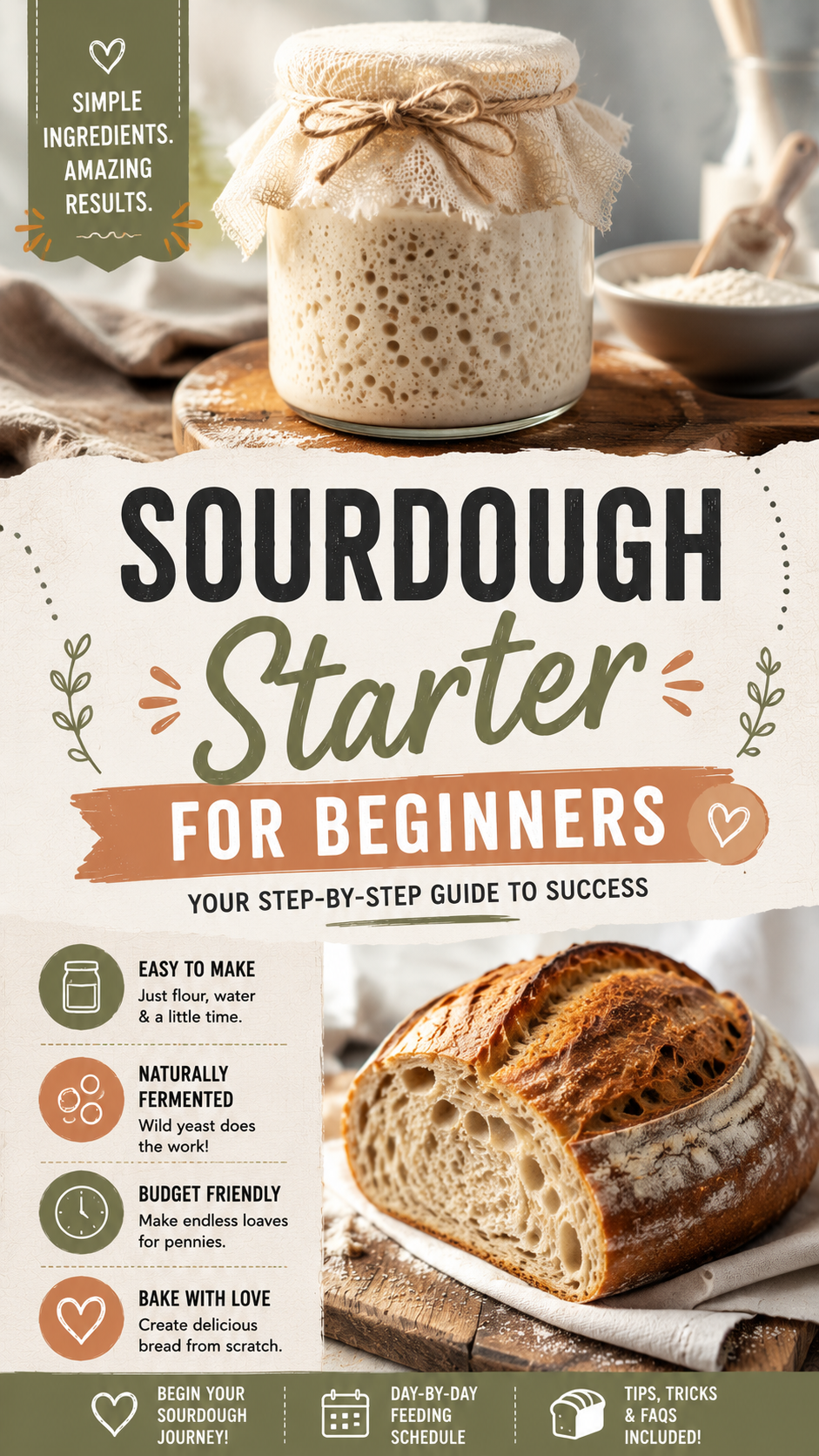
I put off making a sourdough starter for almost two years because I assumed I’d kill it.
Turns out, it’s nearly impossible to kill. It’s just flour, water, and time, doing exactly what flour and water naturally want to do. 🍞
A sourdough starter is wild yeast and bacteria that you grow yourself, right on your counter, using nothing but flour and water.
Once it’s alive and bubbly, it’s what gives sourdough bread its tang, its rise, and that chewy, hole-filled texture everyone loves.
It takes about a week to get going. After that, it can live basically forever if you keep feeding it.
Here’s something that genuinely surprised me: some sourdough starters being used by bakers today are over 100 years old, passed down through families like an heirloom. 🫙
That’s a wild thing to think about while you’re stirring flour and water in a jar on your kitchen counter.
Why Make Your Own Starter
You can buy dehydrated starter online, and plenty of people do.
But making one from scratch costs you almost nothing, and there’s something genuinely satisfying about watching flour and water turn into something alive over the course of a week.
It’s also the only way to get a starter with the exact wild yeast strains living in your own kitchen, which gives your bread a flavor that’s truly yours.
What You’ll Need
- Unbleached all-purpose flour (or whole wheat for the first few days)
- Filtered or dechlorinated water, room temperature
- A clean glass jar (32 oz works well)
- A rubber band or marker for tracking growth
- A clean spoon or spatula for stirring
That’s genuinely it. No special starter packets, no fancy equipment.
Tools You’ll Need
- A kitchen scale (highly recommended, but not required)
- A clean glass jar with room to grow
- A breathable cover, like a cloth or coffee filter secured with a rubber band
- A warm spot in your kitchen, ideally 70-75°F
Day-by-Day Feeding Schedule
This is the part that intimidates most beginners, so here’s exactly what to expect each day.
| Day | What to Do | What You’ll See |
|---|---|---|
| 1 | Mix 50g flour with 50g water in your jar | Smooth, paste-like mixture, no activity yet |
| 2 | Discard half, feed with 50g flour and 50g water | Maybe a few small bubbles, maybe nothing |
| 3 | Discard half, feed with 50g flour and 50g water | More bubbles, possibly a slightly sour smell |
| 4 | Discard half, feed with 50g flour and 50g water | Noticeable rise and bubbling within hours |
| 5 | Discard half, feed with 50g flour and 50g water | Doubling in size, active and bubbly |
| 6 | Discard half, feed with 50g flour and 50g water | Strong rise, ready for a float test |
| 7 | Starter should be doubling consistently | Ready to bake or move to the fridge |
Some starters take a few extra days to get going, especially in cooler kitchens. That’s completely normal, just keep feeding it daily.
How to Make a Sourdough Starter
Step 1: Mix the first feeding
Combine 50g flour and 50g water in your jar, stirring until smooth.
Cover loosely and let it sit at room temperature for 24 hours.
The mixture won’t look like much on day one. It just looks like wet paste, and that’s completely normal.
Step 2: Discard and feed daily
Each day, discard about half the starter, then add 50g fresh flour and 50g fresh water.
Stir well, cover loosely, and let it sit another 24 hours.
The discarding step feels wasteful at first, but it’s necessary. Without it, the starter grows too large and the yeast gets diluted and weak.
Step 3: Watch for bubbles
Around day 3 or 4, you should start seeing small bubbles forming on the surface and sides of the jar.
This means wild yeast is starting to take hold. Keep feeding daily even if it looks slow.
Some days will look more active than others. That back-and-forth is just part of the process, not a sign anything’s wrong.
Step 4: Test for readiness
Around day 6 or 7, your starter should double in size within 4-6 hours of feeding.
Try the float test here. Drop a small spoonful into a glass of water. If it floats, it’s active enough to bake with.
Step 5: Maintain or bake
Once it’s active and doubling reliably, you can either bake with it right away or move it to the fridge to slow things down.
Fridge starters only need feeding once a week instead of daily, which makes upkeep way easier long term.
Pro Tips
These are the details that made the biggest difference for me once I actually understood them.
- Use a kitchen scale. Measuring flour and water by weight instead of cups makes the whole process far more consistent.
- Keep it warm. A starter in a 65°F kitchen takes noticeably longer than one in a 75°F spot.
- Don’t panic over a weird smell early on. Days 2 and 3 can smell a little off, almost like nail polish remover. It usually balances out by day 4 or 5.
- Use whole wheat flour for the first few feedings. It has more natural yeast and bacteria, which can speed up the early growth.
- Don’t give up by day 4. A lot of starters look completely inactive right before they suddenly take off.
- Label your jar with the date. It’s easy to lose track of which day you’re on once you’ve been feeding it for a week straight.
Substitutions and Variations
- No all-purpose flour? Whole wheat or rye both work well, and rye especially tends to ferment faster.
- Tap water instead of filtered? Let it sit out uncovered for an hour first, this helps chlorine evaporate, which can otherwise slow down fermentation.
- Want a faster start? Add a small amount of unwashed organic grape or apple skin to the first feeding. The natural yeast on the skin can help jumpstart things.
- Gluten-free starter? Use a gluten-free flour blend instead, the process is nearly identical, just slightly slower to develop.
Make Ahead Tips
A starter is essentially the ultimate make ahead project, since the whole point is letting it sit and develop over days.
Once established, you can keep it going indefinitely. Some bakers maintain the same starter for decades.
If you know you won’t bake for a while, move it to the fridge and feed it weekly instead of daily to keep it alive with minimal effort.
Nutritional Info & Diet Swaps
Starter itself isn’t really eaten on its own, so nutrition mainly comes into play once it’s baked into bread.
For lower gluten exposure: The long fermentation process in sourdough breaks down some gluten, which is part of why many people tolerate sourdough better than other breads. This doesn’t make it gluten-free, just potentially easier to digest for some people.
For a milder, less tangy flavor: Feed your starter more frequently, even twice a day, which keeps the acidity lower.
Meal Pairing Suggestions
Once your starter is active, here’s where the fun really begins.
- Classic sourdough bread: The obvious first project, and the best way to test if your starter’s ready.
- Sourdough pancakes: A great way to use discard instead of tossing it.
- Sourdough pizza dough: Adds a subtle tang that plain dough doesn’t have.
Time-Saving Tips
- Set a daily reminder for feeding times, missing a day or two early on can slow your progress significantly.
- Use discard in other recipes instead of throwing it away, like pancakes, crackers, or waffles.
- Move to the fridge once established to cut daily feeding down to weekly.
Leftovers and Storage
Once active, store your starter in the fridge with a loose-fitting lid, feeding it once a week.
If you bake often, keeping it at room temperature and feeding daily works better, since it stays more active and ready to use.
Discard can be stored in the fridge for several days and used in plenty of recipes that call for it.
FAQ
Why does my starter have a layer of dark liquid on top? That’s called hooch, and it just means your starter is hungry. Stir it back in or pour it off, then feed as usual.
Can I use bottled water instead of filtered? Yes, as long as it’s not distilled, which can sometimes lack the minerals yeast needs to thrive.
How do I know if my starter died? A true dead starter will develop mold or smell genuinely rotten, not just sour. Most “dead” starters are actually just hungry and bounce back with consistent feeding.
Do I need to use the same flour every time? It’s best to stick with one type once established, since switching frequently can slow down consistency.
Can I speed up the whole process? Not really, beyond keeping it warm and feeding consistently. Fermentation just takes the time it takes.
Can I go on vacation without killing my starter? Yes, just move it to the fridge before you leave. It can go 1-2 weeks without feeding in there with no issues.
Wrapping Up
A sourdough starter looks like a big commitment from the outside, but it’s really just flour, water, and a week of patience.
Follow the feeding schedule above, watch for those first bubbles, and trust the process even when it looks slow.
Once it’s active, you’ll have something that can make bread, pancakes, and pizza dough for years to come.
If you try this one, leave a comment below and let me know how your starter turned out, or which day it finally came alive for you. I’d love to hear about it.