My husband took one bite of this and said, “You need to make this every week.” That’s the highest compliment I’ve ever gotten in a kitchen.
Beef stew has this reputation of being something your grandma makes on a Sunday while you sit at her table doing absolutely nothing. And honestly? That’s exactly the vibe. It’s deeply savory, fall-apart tender, and the kind of meal that fills the whole house with a smell so good it’s almost unfair.
Here’s the thing most people get wrong: they rush it.
This recipe doesn’t rush. And that’s exactly why it’s so good. Keep reading, because there’s one step in here most people skip that completely changes the final result.
What You’ll Need
For the Stew:
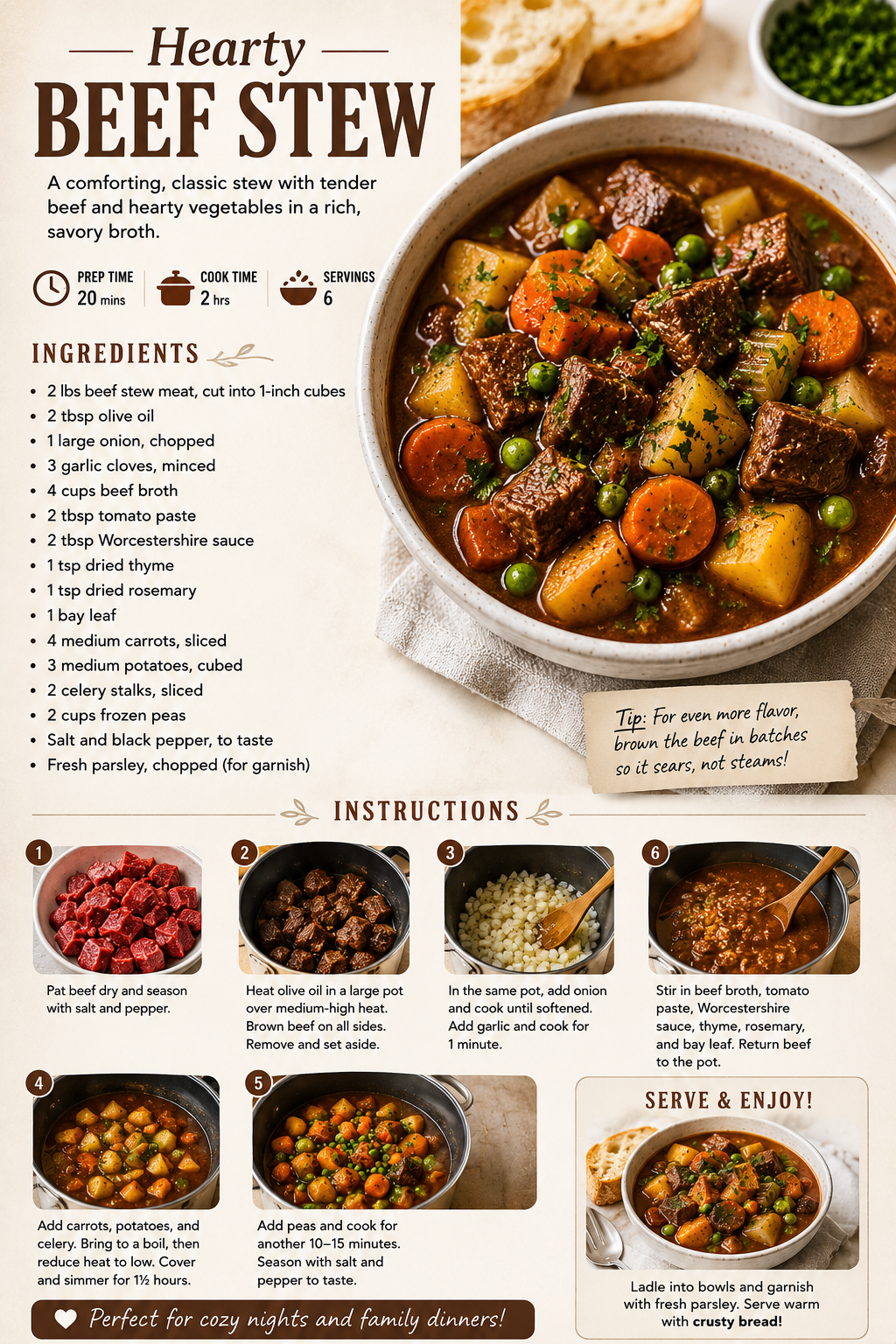
- 2 lbs beef stew meat, cut into 1.5-inch cubes (chuck roast works perfectly)
- 3 tablespoons olive oil, divided
- 1 large yellow onion, diced
- 4 cloves garlic, minced
- 3 medium carrots, cut into 1-inch pieces
- 3 medium Yukon Gold potatoes, cut into 1.5-inch chunks
- 2 stalks celery, sliced
- 2 tablespoons tomato paste
- 2 tablespoons all-purpose flour
- 2 cups beef broth (low sodium)
- 1 cup red wine (Cabernet Sauvignon or Merlot — something you’d actually drink)
- 1 can (14 oz) diced tomatoes, drained
- 1 tablespoon Worcestershire sauce
- 2 teaspoons fresh thyme (or 1 tsp dried)
- 1 teaspoon fresh rosemary, finely chopped (or 1/2 tsp dried)
- 2 bay leaves
- Salt and black pepper, to taste
- Fresh parsley, for garnish
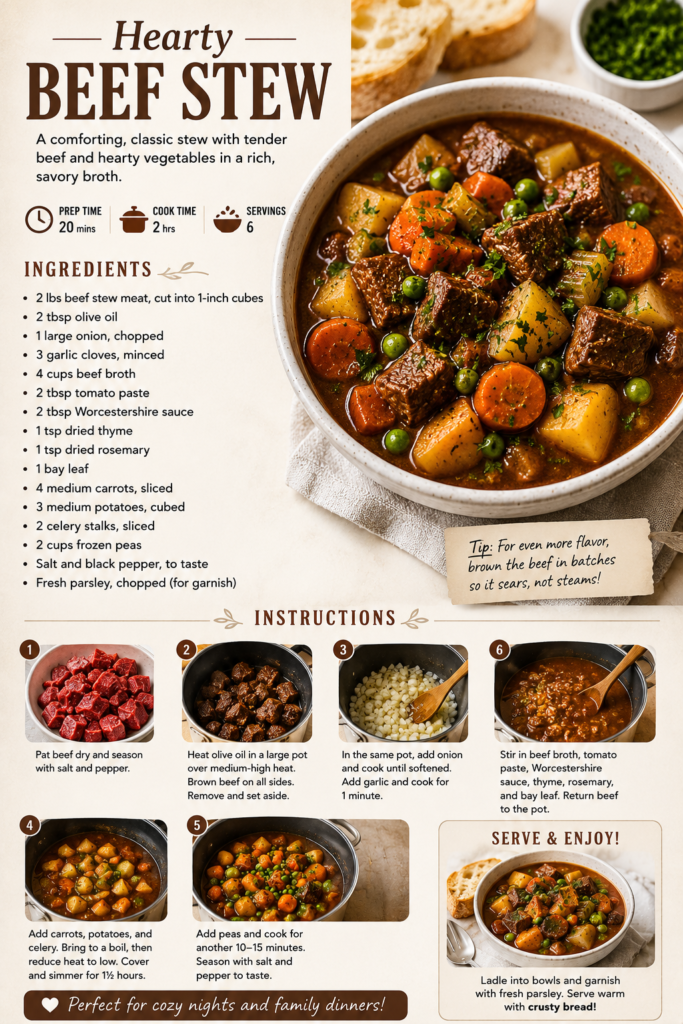
Tools You’ll Need
- Large Dutch oven or heavy-bottomed pot (5–6 quart)
- Sharp chef’s knife
- Cutting board
- Wooden spoon or silicone spatula
- Measuring cups and spoons
- Ladle
- Paper towels (for patting the beef dry — don’t skip this)
Pro Tips
These are the things I wish someone had told me the first time I made beef stew.
- Pat the beef completely dry before searing. This is the step most people skip. Wet meat steams instead of sears, and you lose that gorgeous brown crust that gives the stew its depth of flavor. Paper towels are your best friend here.
- Don’t crowd the pan. Sear the beef in two or three batches. If you throw it all in at once, it steams. You want a proper, hard sear on each piece — a deep mahogany brown.
- Deglaze properly. When you add the wine, scrape up every single brown bit stuck to the bottom of the pot. That stuff is pure flavor and you do not want to waste it.
- Low and slow wins every time. This stew needs a minimum of 1.5 hours of simmering. Two hours is even better. The patience is exactly what makes the beef fall apart like it does.
- Add the potatoes and carrots later. If you toss them in too early, they turn to mush. Add them in the last 40–45 minutes so they stay tender but intact.
How to Make It
Step 1: Season and Sear the Beef
Pat your beef cubes completely dry with paper towels. Season generously with salt and black pepper on all sides.
Heat 2 tablespoons of olive oil in your Dutch oven over medium-high heat until shimmering.
Working in batches (don’t overcrowd), sear the beef for about 2–3 minutes per side until deeply browned. Transfer to a plate and set aside.
This part takes patience. Pour yourself a glass of that wine while you wait.
Step 2: Build the Base
Reduce heat to medium. Add the remaining tablespoon of oil.
Add the diced onion and celery to the pot. Cook, stirring occasionally, for 4–5 minutes until softened and starting to turn golden.
Add the minced garlic and tomato paste. Stir everything together and cook for another 2 minutes. The tomato paste will deepen in color and smell incredible.
Step 3: Deglaze with Wine
Pour in the red wine and use your wooden spoon to scrape up all those browned bits stuck to the bottom of the pot.
Let it simmer for 2–3 minutes until the wine reduces slightly and the sharp alcohol smell mellows out.
Step 4: Add the Liquid and Beef Back In
Add the beef broth, diced tomatoes, Worcestershire sauce, thyme, rosemary, and bay leaves. Stir to combine.
Return the seared beef (and any juices on the plate) back into the pot.
Bring everything to a gentle boil, then reduce heat to low. Cover and let it simmer for 45 minutes.
Step 5: Add the Vegetables
After 45 minutes, add the carrots and potatoes. Stir everything together, then cover and continue simmering for another 40–45 minutes, until the vegetables are fork-tender and the beef is falling apart.
Step 6: Thicken the Stew
In a small bowl, mix 2 tablespoons of flour with 3 tablespoons of cold water until smooth. Slowly stir this into the stew.
Simmer uncovered for another 10–15 minutes, stirring occasionally, until the broth thickens to a gorgeous, glossy consistency.
Remove the bay leaves.
Step 7: Taste and Finish
Taste for seasoning and adjust salt and pepper as needed.
Ladle into bowls, scatter fresh parsley on top, and serve immediately.
Substitutions and Variations
Not everyone has the same pantry — or the same dietary needs. Here’s how to make it work for you:
| Swap | Use Instead |
|---|---|
| Red wine | Extra beef broth + 1 tbsp balsamic vinegar |
| All-purpose flour | Cornstarch slurry (1.5 tbsp cornstarch + 2 tbsp water) for a gluten-free version |
| Yukon Gold potatoes | Sweet potatoes or parsnips for a different flavor profile |
| Fresh thyme/rosemary | Italian seasoning works in a pinch |
| Beef stew meat | Bone-in short ribs for an even richer stew |
Want to make it heartier? Add a cup of frozen peas in the last 5 minutes. The pop of green makes it look beautiful too.
Slow cooker version? Sear the beef and build the base as directed, then transfer everything to a slow cooker and cook on LOW for 8 hours or HIGH for 4–5 hours. Add vegetables halfway through.
Make-Ahead Tips
This stew is actually better the next day. The flavors deepen overnight in a way that’s genuinely hard to explain until you’ve experienced it.
- Make it up to 3 days ahead and store in the fridge in an airtight container.
- The stew thickens significantly as it cools. Add a splash of broth when reheating and stir to loosen.
- You can also make it through Step 4 (before adding vegetables), refrigerate overnight, and finish it fresh the next day.
Nutrition Breakdown (Per Serving, Approx.)
Based on 6 servings
| Nutrient | Amount |
|---|---|
| Calories | ~420 kcal |
| Protein | 35g |
| Carbohydrates | 28g |
| Fat | 16g |
| Fiber | 4g |
| Sodium | ~580mg |
This is a protein-heavy, nutrient-dense meal. The beef provides iron and B vitamins, the carrots bring beta-carotene, and the potatoes add potassium. Honestly, it’s comfort food that you can feel genuinely good about eating.
Meal Pairing Suggestions
Beef stew is pretty much a complete meal on its own, but if you want to round it out:
- Crusty sourdough bread — for scooping up every last drop of broth (non-negotiable in my opinion)
- Simple green salad — something light and acidic to balance the richness
- Egg noodles or mashed potatoes — if you want to serve the stew over something instead of on its own
- A glass of the same red wine you cooked with — this just makes sense
Leftovers and Storage
Refrigerator: Store in an airtight container for up to 4 days. The flavor genuinely improves on day two.
Freezer: This stew freezes beautifully. Let it cool completely, then transfer to freezer-safe containers. It keeps well for up to 3 months.
Reheating: Reheat on the stovetop over medium-low heat, stirring occasionally. Add a splash of broth if it’s thickened too much. Avoid microwaving if you can — the stovetop keeps the meat texture much better.
One important note: If you’re freezing, consider leaving the potatoes out and adding fresh ones when you reheat. Potatoes can get a little grainy after freezing, though it’s not a dealbreaker.
FAQ
Can I use a different cut of beef? Chuck roast is the gold standard for stew. It has the right fat content to become tender and flavorful with long cooking. Avoid lean cuts like sirloin — they get tough and dry.
My stew isn’t thickening. What do I do? Make sure you’re simmering with the lid off in the final stage. You can also add another cornstarch slurry (1 tablespoon cornstarch + 1.5 tablespoons cold water) and simmer for a few extra minutes.
Can I skip the wine? Yes. Replace it with equal parts beef broth, plus a splash of balsamic vinegar for depth. The stew will still be really good — just slightly less complex in flavor.
Do I have to sear the beef first? Technically, no. But the difference in flavor is enormous. The searing creates the Maillard reaction — basically, it’s science that makes food taste better. It’s worth the extra 10 minutes.
Can I make this in an Instant Pot? Yes. Use the sauté function to sear the beef and build the base, then pressure cook on HIGH for 35 minutes. Do a natural release for 15 minutes. Add cooked vegetables (steamed separately) before serving so they don’t turn to mush.
The beef is tough after an hour. Did I do something wrong? Not necessarily. Tough beef usually just means it needs more time. Keep simmering and check again at the 30-minute mark. It will get there.
Wrapping Up
If you’ve made it this far, you already know this stew is worth making. 🍲
It’s the kind of meal that turns an ordinary Tuesday into something worth sitting down for. The kind that your family asks about days later. The kind that makes you feel oddly proud of yourself for something that mostly involved just waiting.
Give it a go this week. And when you do, drop a comment below — tell me how it turned out, what you swapped, or if you ate the whole pot in one sitting. (No judgment whatsoever.)
Questions? Those are welcome too.