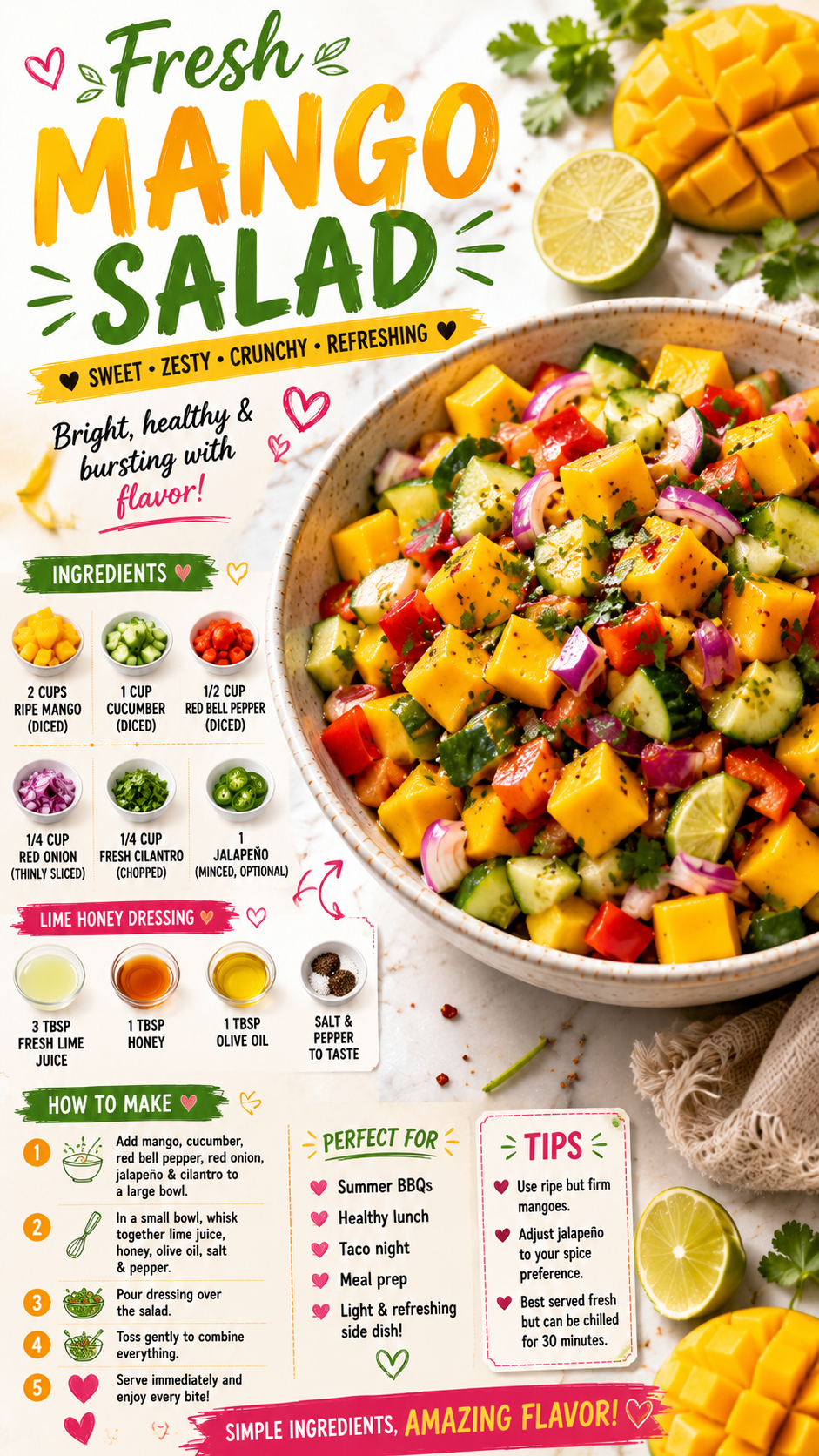
This salad has no business being this good for how fast it comes together.
We’re talking ripe mango, crisp cucumber, thinly sliced red onion, colorful bell pepper, fresh cilantro — all tossed in a lime dressing with just enough heat to keep things interesting. It’s the kind of dish that makes you feel like you’re eating somewhere really good, not just standing over your kitchen counter.
And the 15-minute part? Completely real.
No cooking. No complicated technique. Just some good chopping, a quick dressing, and one of the freshest, most satisfying salads you’ll make all summer.
There’s one dressing trick in here that keeps this from tasting flat — and it’s not what most people expect. Keep reading.
What You’ll Need
For the Salad
- 2 large ripe mangoes, peeled and diced into ¾-inch cubes (about 3 cups)
- 1 medium English cucumber, halved and sliced into half-moons
- 1 medium red bell pepper, thinly sliced
- ½ medium red onion, very thinly sliced
- ½ cup fresh cilantro leaves, roughly chopped
- 1 jalapeño, thinly sliced (seeds removed for less heat, kept in for more)
- ¼ tsp chili flakes (optional, for extra kick)
For the Lime Dressing
- 3 tbsp fresh lime juice (about 2 limes)
- 1 tbsp extra virgin olive oil
- 1 tbsp honey or agave
- 1 tsp fish sauce (the secret ingredient — see Pro Tips)
- ¼ tsp salt
- ¼ tsp black pepper
Tools You’ll Need
- Large mixing bowl
- Sharp chef’s knife
- Cutting board
- Small bowl or jar (for the dressing)
- Whisk or fork
- Citrus juicer or hand squeezer
- Vegetable peeler (for the mango)
- Serving bowl
Pro Tips
These small things make a real difference here.
- Add fish sauce to the dressing. This is the move most people skip and then wonder why their mango salad tastes a little flat. Fish sauce adds a deep, savory umami layer that you can’t quite identify but absolutely notice when it’s there. It doesn’t taste “fishy” at all in the final salad — it just makes everything taste more complex and balanced. Start with 1 teaspoon and work up from there. (For a vegan version, substitute 1 tsp of soy sauce or tamari.)
- Slice the red onion thin and soak it. Thick-cut red onion can overpower everything else in the bowl. Slice it as thin as you can, then soak the slices in cold water for 10 minutes before adding. This takes away the sharp bite and leaves you with a mild, slightly sweet onion flavor that complements the mango instead of fighting it.
- Use ripe but firm mangoes. Overripe mangoes turn mushy the moment they hit the dressing and make the whole salad soggy. You want mangoes that give slightly when pressed but still hold their shape when cut. Ataulfo (yellow/honey mangoes) or Tommy Atkins both work well here.
- Dress right before serving. The lime juice starts softening the mango and cucumber pretty quickly. If you’re making this ahead, keep the dressing separate and toss right before it hits the table.
- Taste and balance. This dressing is a balance of sour (lime), sweet (honey), salty (fish sauce + salt), and spicy (jalapeño + chili flakes). Taste it before adding to the salad and adjust. If it’s too sharp, add a little more honey. Too sweet, add more lime. Too mild, add chili flakes.
Substitutions and Variations
Mango: Papaya works beautifully here for a different but equally tropical version. Green (unripe) mango is also excellent if you want a tangier, crunchier salad — it’s the base of traditional Thai green mango salad.
Cucumber: Regular cucumber works fine — just peel and seed it first. Persian cucumbers are also great.
Red onion: Shallots make a milder substitute. Spring onions (scallions) are a good option if you want something even lighter.
Fish sauce: Soy sauce or tamari for a vegan version. Coconut aminos work too.
Cilantro: If cilantro isn’t your thing (it’s a genuine love-it-or-hate-it herb), fresh mint or Thai basil are excellent swaps that still give the salad a bright, fresh finish.
Flavor variations:
- Add ½ cup of diced avocado right before serving for a creamier version
- Toss in ¼ cup of toasted coconut flakes for a tropical crunch
- Add cooked, chilled shrimp to turn this into a light lunch
- Swap the lime dressing for a sesame-ginger dressing for an Asian-inspired version
- Add a handful of crushed roasted peanuts on top — the crunch is excellent
Make Ahead Tips
This salad is best fresh, but there are ways to prep it ahead smartly.
Components: Dice the mango, slice the vegetables, and make the dressing separately. Store each in airtight containers in the fridge for up to 24 hours.
Red onion: Soak, drain, and store in the fridge up to a day ahead.
Dressing: Keeps refrigerated for up to 5 days in a sealed jar.
Full salad (undressed): Holds in the fridge for up to 4 hours before the textures start to soften noticeably.
Do not dress ahead if you want crisp cucumber and firm mango — the acid in the lime juice starts breaking everything down within about 30 minutes.
How to Make Fresh Mango Salad
Step 1: Prep the Onion
- Thinly slice the red onion and place in a small bowl of cold water.
- Let soak for 10 minutes while you prep the rest of the salad.
Step 2: Make the Dressing
- In a small bowl or jar, combine lime juice, olive oil, honey, fish sauce, salt, and pepper.
- Whisk well until the honey is fully dissolved and the dressing looks cohesive.
- Taste and adjust — more lime if too sweet, more honey if too sharp, more salt if it tastes flat.
Step 3: Prep the Salad Ingredients
- Peel and dice the mangoes into ¾-inch cubes.
- Slice the cucumber into half-moons.
- Thinly slice the red bell pepper.
- Slice the jalapeño (remove seeds for mild heat).
- Drain and pat dry the soaked red onion slices.
- Roughly chop the cilantro.
Step 4: Assemble
- Add all salad ingredients to a large bowl: mango, cucumber, bell pepper, red onion, jalapeño, and cilantro.
- Pour the dressing over everything.
- Toss gently — mango pieces are delicate and you don’t want them to break apart.
- Add chili flakes if using.
- Taste one more time, adjust seasoning, and transfer to a serving bowl.
Serve immediately.
Nutrition Breakdown
Per serving, based on 4 servings
| Nutrient | Amount |
|---|---|
| Calories | ~160 kcal |
| Total Fat | 4g |
| Saturated Fat | 0.5g |
| Carbohydrates | 32g |
| Sugar | 26g |
| Protein | 2g |
| Sodium | 310mg |
| Fiber | 3g |
| Vitamin C | ~85% DV |
Estimates only. Mango variety and ripeness affect sugar content.
Dietary Info
| Diet | Status |
|---|---|
| Vegan | ✓ (swap fish sauce for soy sauce or tamari) |
| Vegetarian | ✓ (same swap) |
| Gluten-free | ✓ (verify fish sauce brand is GF) |
| Dairy-free | ✓ |
| Nut-free | ✓ |
| Paleo | ✓ (use coconut aminos, skip honey or use maple syrup) |
| Low-calorie | ✓ (under 200 calories per serving) |
What to Serve It With
This salad works as a side, a topping, or honestly its own light lunch.
- Grilled fish or shrimp tacos — the mango salad doubles as a topping and it’s a really good combination
- Grilled chicken thighs — the sweetness and acidity cut right through rich grilled meat
- Coconut rice — serve the salad spooned over a bowl of warm coconut rice for a complete meal
- Pulled pork — a surprisingly great pairing; the mango sweetness balances the smoke
- On its own with some tortilla chips for scooping — genuinely excellent as a mango salsa situation
Leftovers and Storage
Same day: This salad is at its absolute peak within the first hour of being dressed.
Leftovers: Store in an airtight container in the fridge for up to 24 hours. The flavors actually meld nicely overnight, but the textures soften. Still very good — just different.
Do not freeze. Mango and cucumber don’t survive freezing well at all.
Tip: If you have leftover undressed salad components, they keep separately in the fridge for 1–2 days. Dress only what you’ll eat.
FAQ
How do I pick a ripe mango? Don’t go by color — it varies by variety. Go by feel. A ripe mango will give slightly when you press it gently, similar to a ripe peach. It should also smell sweet near the stem end. Avoid anything that feels mushy or has wrinkled skin.
Can I use frozen mango? For this salad, fresh is strongly preferred. Frozen mango gets soft and watery when thawed and releases a lot of liquid into the dressing. The texture won’t hold up.
My salad is too sweet. How do I fix it? Add more lime juice and a small pinch of salt. If you have it, a tiny splash more fish sauce or soy sauce also helps balance the sweetness. Chili flakes or fresh jalapeño are also good tools here — heat cuts sweetness.
Can I make this without cilantro? Yes. Fresh mint is the closest swap in terms of brightness. Thai basil also works really well. If you want to skip fresh herbs entirely, the salad still tastes good — just a little less vibrant.
Is this spicy? With the jalapeño seeds removed and no chili flakes, it has a very mild warmth. With seeds in and chili flakes added, it has a noticeable but not overwhelming heat. Adjust completely to your preference.
What’s the best mango variety to use? Ataulfo (also called honey or champagne mango — the small yellow ones) are incredible in this salad. They’re sweeter, less fibrous, and hold their shape well. Tommy Atkins (the large red-green variety most common in grocery stores) also works well and is easier to find.
Wrapping Up
This mango salad is genuinely one of those recipes that looks like you put in way more effort than you did.
It’s fresh, it’s colorful, it’s done in 15 minutes, and it goes with almost anything on a summer table. The fish sauce trick alone is worth making this at least once — it’s the kind of small thing that changes how you think about salad dressings entirely.
Give it a try and leave a comment below. Tell me which variation you went with, what you paired it with, and any tweaks that worked really well for you. 👇