You open a jar of homemade jam and the smell hits you before you even get it to the counter.
That’s the moment. That’s when you realize you’ve been settling.
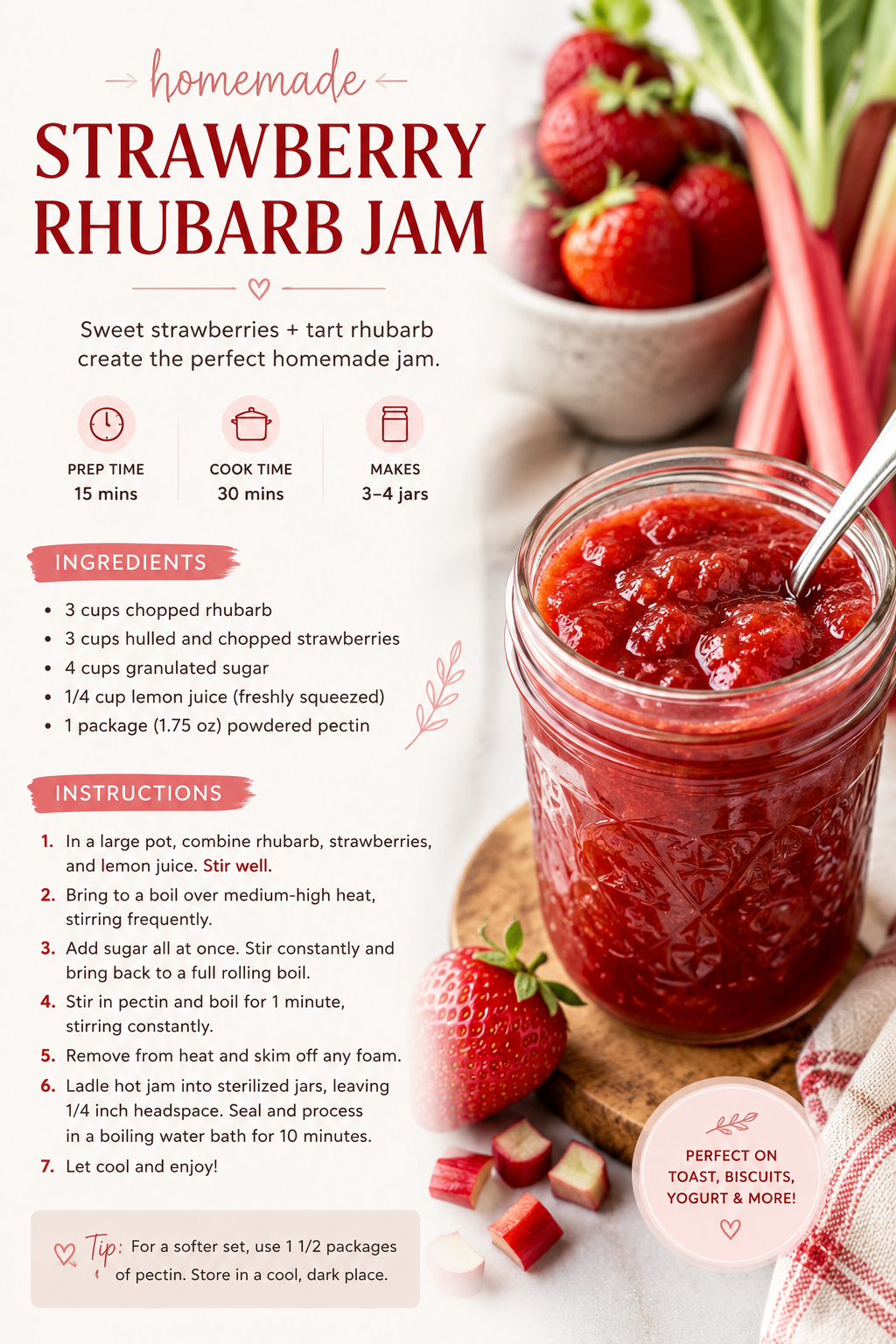
Strawberry rhubarb jam is one of those recipes that sounds fancy but is genuinely one of the easiest things you’ll ever make in your kitchen. Two main ingredients. A little sugar. A little heat. And the result is a deep, jammy, sweet-tart spread that goes on absolutely everything.
Fair warning: once you make this, a grocery store jar is going to feel like a personal insult. 😅
What Makes This Combo So Good?
Strawberries are sweet and floral. Rhubarb is sharp and almost sour on its own.
Together? They cancel each other’s extremes and create something perfectly balanced. The rhubarb keeps the jam from being cloying, and the strawberries mellow out the tartness.
It’s one of those flavor combos that just works — and people have known this since at least the 1800s. Rhubarb was actually so commonly paired with sweet fruits that it earned the nickname “the pie plant.” Not exactly a glamorous title, but it’s earned.
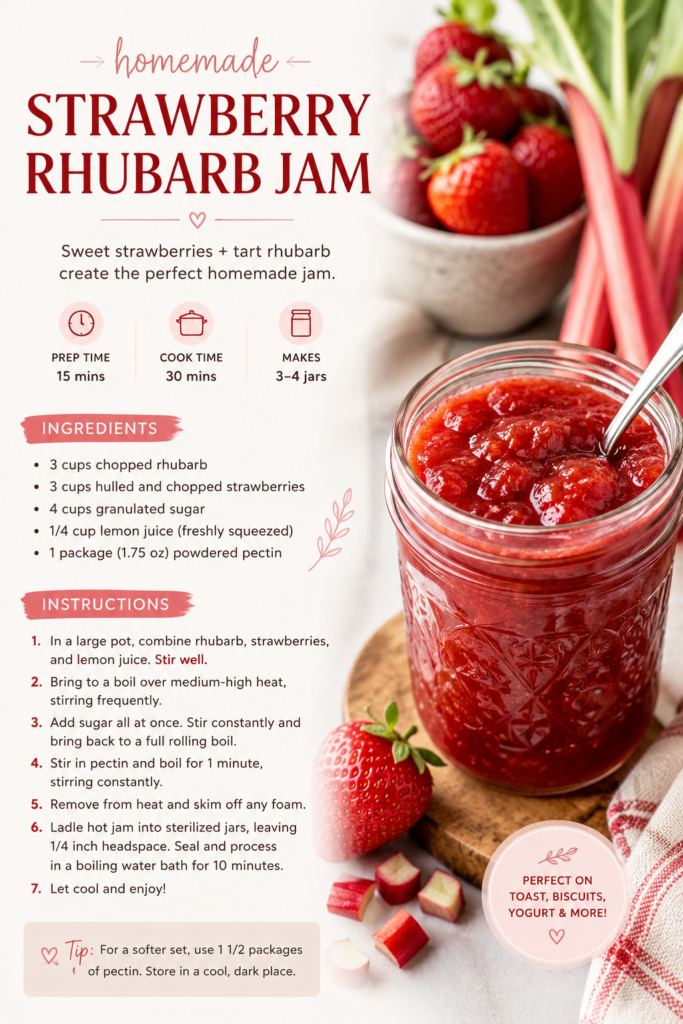
What You’ll Need
For the Jam
- 2 cups fresh strawberries, hulled and roughly chopped
- 2 cups rhubarb stalks, trimmed and cut into ½-inch pieces (only the stalks — never the leaves, which are toxic)
- 1½ cups granulated white sugar
- 2 tablespoons fresh lemon juice
- 1 teaspoon lemon zest (optional, but adds a nice brightness)
- ½ teaspoon vanilla extract (optional, rounds out the flavor)
That’s it. Six ingredients, one pot, one jar.
Tools You’ll Need
- Large heavy-bottomed saucepan or Dutch oven (the heavy base prevents scorching)
- Wooden spoon or heat-resistant silicone spatula
- Potato masher or fork (for breaking down fruit)
- Ladle
- Sterilized mason jars with lids (two 8 oz jars or one 16 oz jar)
- Instant-read thermometer (optional but helpful — jam sets at 220°F / 104°C)
- Small plate in the freezer (for the wrinkle test — more on that below)
- Jar lifter or kitchen tongs
- Cutting board and sharp knife
Pro Tips
These are the things that made a real difference when I was testing this recipe:
- Don’t skip macerating the fruit. Toss your strawberries and rhubarb with the sugar and let them sit for at least 30 minutes before cooking. This pulls out the juices naturally and means less time on the stove. The color it turns is honestly gorgeous.
- Low and slow wins. Resist cranking the heat. Medium-low heat gives you more control and means less chance of burning the bottom. Jam scorches fast and bitter burned jam is non-negotiable trash.
- Use the frozen plate test. Stick a small plate in the freezer when you start cooking. When the jam looks thick, drop a tiny spoonful on the cold plate and push it with your finger. If it wrinkles and holds its shape, it’s done. If it runs, keep going.
- Skim the foam. You’ll get a layer of pink foam rising to the top as the jam cooks. Skim it off with a spoon. It won’t hurt you, but it makes the final jam look much cleaner and prettier in the jar.
- Sterilize your jars properly. Run them through the dishwasher on the hottest setting or submerge them in boiling water for 10 minutes. Skipping this shortens shelf life dramatically.
How to Make Strawberry Rhubarb Jam
Step 1: Macerate the Fruit
Add your chopped strawberries, rhubarb, and all the sugar to a large bowl.
Stir to coat everything, then cover and let it sit at room temperature for 30 minutes to 1 hour.
You’ll notice the sugar pulling out the fruit juices and creating a beautiful ruby-pink syrup at the bottom. That’s exactly what you want.
Step 2: Cook the Jam
Pour the macerated fruit and all the liquid into your heavy-bottomed saucepan.
Add the lemon juice and lemon zest.
Bring it to a boil over medium heat, stirring often. Once boiling, reduce to a steady simmer and keep stirring every few minutes to prevent sticking.
Cook for 20 to 30 minutes, using a potato masher or fork to break down any large chunks as you go.
Step 3: Test for Set
Pull that cold plate out of the freezer.
Drop a small spoonful of jam onto it, wait 30 seconds, then push it with your finger. If it wrinkles and holds its shape, you’ve hit the set point.
If it’s still very liquid, keep simmering and test again in 5 minutes.
Step 4: Add Vanilla (Optional)
Remove from heat. Stir in the vanilla extract if using.
Let it sit for 2-3 minutes, then skim off any foam from the surface.
Step 5: Jar the Jam
Using a ladle, carefully pour the hot jam into your sterilized mason jars, leaving about ¼ inch of headspace at the top.
Wipe the rims clean, then seal with the lids.
For short-term storage: Let the jars cool to room temperature, then refrigerate. Use within 3 weeks.
For long-term storage: Process in a boiling water bath for 10 minutes after sealing. Properly processed jars are shelf-stable for up to 12 months.
Substitutions and Variations
| Swap | What It Does |
|---|---|
| Frozen strawberries | Works great — no need to macerate as long, they’ll release liquid faster |
| Frozen rhubarb | Totally fine, thaw and drain slightly before using |
| Honey instead of sugar | Use ¾ the amount of honey; adds a floral note |
| Maple syrup instead of sugar | Gives a slightly earthy sweetness |
| Add 1 tsp fresh ginger | Adds warmth and a little kick |
| Add ½ tsp cinnamon | Makes it feel more autumn-forward |
| Use lime instead of lemon | Slightly different brightness, still works well |
| Add pectin | For a stiffer set, follow package directions |
Make-Ahead Tips
This jam is genuinely a make-ahead hero.
- Make a big batch on a Sunday afternoon and it keeps in the fridge for 3 weeks without any special processing.
- Water-bath can the jars and they’ll last a full year in your pantry.
- Macerate the fruit the night before and leave it in the fridge overnight. Morning-of cooking goes even faster.
Nutritional Breakdown
Per 1 tablespoon serving (approximate):
| Nutrient | Amount |
|---|---|
| Calories | ~45 kcal |
| Carbohydrates | ~11g |
| Sugar | ~10g |
| Fiber | ~0.3g |
| Vitamin C | ~5% DV |
| Calcium | ~1% DV |
Dietary notes:
- Naturally vegan and gluten-free
- To reduce sugar: swap ¼ of the sugar for a low-glycemic sweetener like erythritol — texture will be slightly different but flavor holds up
- No pectin needed for this recipe, so it stays as clean-label as homemade gets
What to Eat It With
Don’t just stop at toast. This jam has range.
- On sourdough with salted butter and a little flaky sea salt on top
- Swirled into plain yogurt for a quick breakfast that feels way more put-together than it is
- On a cheese board next to brie or aged cheddar (trust this one)
- As a glaze for roasted chicken or pork chops — sweet-tart cuts through the richness beautifully
- Stirred into oatmeal in the last minute of cooking
- On top of vanilla ice cream straight from the jar (no judgment here)
- In a PB&J — honestly a game changer compared to standard grape jelly
Leftovers and Storage
Refrigerator: Up to 3 weeks in a sealed jar. Always use a clean spoon — no double-dipping or it introduces bacteria and shortens the life.
Freezer: Pour cooled jam into freezer-safe containers, leaving ½ inch of headspace. Freezes well for up to 12 months. Thaw overnight in the fridge.
Pantry (water-bath canned jars): Up to 12 months in a cool, dark spot. Once opened, treat like refrigerator storage — use within 3 weeks.
If your jam ever looks, smells, or tastes off — or shows any mold — toss it. Not worth it.
FAQ
Can I use only strawberries and skip the rhubarb? You can, but you’ll end up with standard strawberry jam. The rhubarb is what gives this its signature tartness and complexity. If you’re rhubarb-shy, start with a 3:1 strawberry-to-rhubarb ratio and work from there.
My jam isn’t thickening — what happened? Keep cooking. Some batches take longer depending on how much liquid your fruit released. Check every 5 minutes with the plate test and be patient. If it’s still thin after 40 minutes, add a small amount of liquid pectin and cook for another 5 minutes.
Do I have to peel the rhubarb? No. The skin is completely edible and breaks down during cooking. Just trim the ends and chop.
Can I use rhubarb leaves? No. Rhubarb leaves contain oxalic acid and are toxic. Only the stalks (the red and green part you’d find at a grocery store) are safe to eat.
Can I halve the sugar? You can reduce it, but sugar isn’t just for sweetness here — it’s part of how the jam sets and preserves. If you go below 1 cup for this batch size, your jam may not set properly and will have a shorter shelf life. Adding pectin can help compensate.
Why is my jam too runny after cooling? It likely needed more cooking time. Reheat gently in the same saucepan, continue simmering, and test again. It will come together.
Is rhubarb a fruit or a vegetable? Botanically, it’s a vegetable. But legally in the United States, a New York court ruled in 1947 that rhubarb is a fruit — because it was imported and used like one, and tariffs for fruits were lower. So it’s a vegetable that is legally a fruit. 🌱
Wrapping Up
Strawberry rhubarb jam is the kind of recipe that you make once and it just becomes part of your regular rotation.
It’s genuinely simple, the ingredients are cheap and easy to find in season, and the payoff is one of those things that makes you feel like you actually have your kitchen life together.
Put a jar of this in someone’s hands and watch their face. That reaction? Worth every minute.
Now go make a batch, and when you do, drop a comment below. Tell me what you put it on first, or ask anything you need to. I read every single one. 🍓